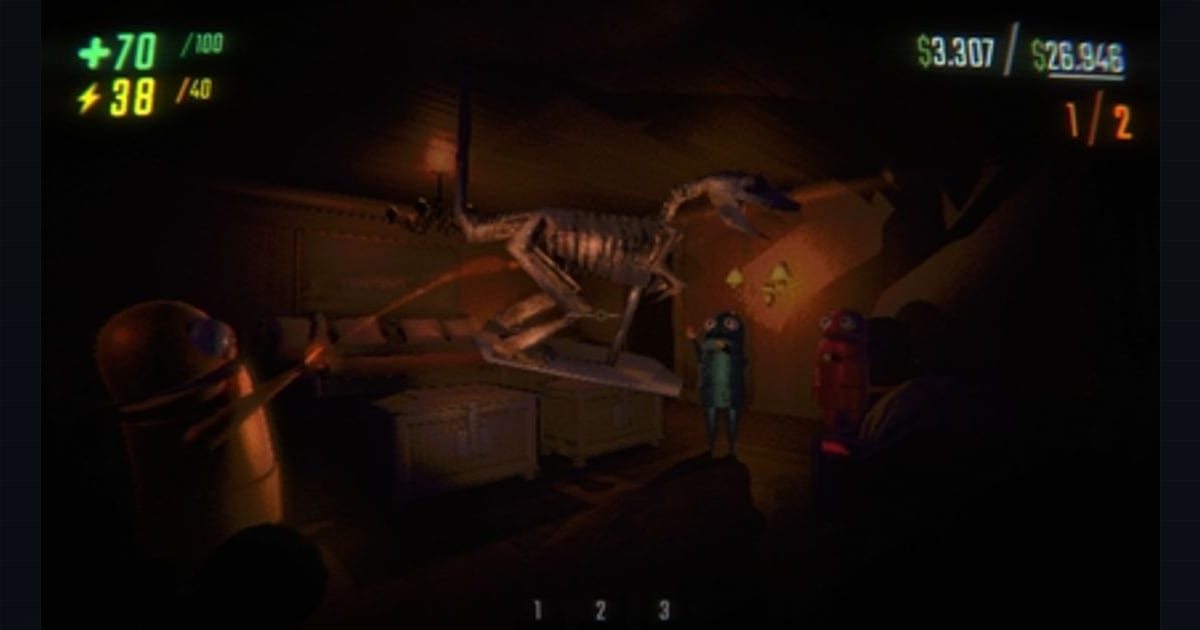
R.E.P.O.’s monsters are documented in detail by one player’s Steam guide, last updated 9 January 2026 — the catalogue this piece prices. Two major updates have landed since — the Cosmetic Update on 7 May and The Sunstone Update on 29 October — plus five point releases, and the current build is v0.5.1, published on 5 November. So the guide that describes the Trudge is older than the patch that reworked its vacuum to the Void Staff’s suck.
That is not a knock on the guide. It is the shape of this game’s documentation. semiwork writes patch notes, and those notes usually name an existing monster only in the release where it was changed or fixed. A new enemy is the exception.
What this covers: all 29 monsters in that catalogue — what each one punishes, and the cost where a source states one, whether that is a slice of a 100-health bar, part of a haul, or a minute of a level. Why it matters: semiwork’s notes describe an enemy’s behaviour only when that behaviour was changed or fixed, so most of what a monster costs you is community-observed and dated to v0.3.x. What this is not: a tier list, or a promise that any of these numbers survived the Sunstone rebalance. Where a figure comes from the guide rather than the developer, the sentence says so.
What semiwork actually confirms about monsters
The most reliable thing in the feed is a negative. In v0.5.0, under BALANCING, exactly one enemy appears: “Enemy Elsa - Elsa now generates less overcharge while in small form and not stunned.” One monster was rebalanced in the Sunstone Update, and the change was to overcharge generation, not damage.
Everything else about enemies sits under FIXES, where the useful detail hides. Five monsters get a line each, and every line accidentally describes the monster. The Mentalist’s — “Fixed the red sphere effect not being removed when its attack is interrupted” — tells you the attack has a red aura and a window. The Spewer’s — “Overlay no longer gets stuck if the Spewer dies while attaching” — tells you it overlays your screen.
Then there is Pony, the one enemy v0.5.0 added: “New Enemy - Pony!” on 29 October, followed on 5 November by “Enemy Pony - Adjusted riding position and prevented collisions between the pony and its rider.” Two sentences, both structural, neither about behaviour. Pony is the newest monster in the game and the least documented thing in it.
For scale, the Monster Update on 30 October 2025 shipped “10 new enemies!” and that is the last time semiwork published a monster number.
The list this article prices is a community list, and it says so
The catalogue is “R.E.P.O The Definitive Guide (Monster update)” on Steam, by a player called Alive: 218 ratings, 13,177 unique visitors, posted in August 2025 and updated as recently as 9 January 2026. Its framing sentence is “There is a total of 29 unique monsters that you can encounter during your mission.”
I counted the entries, and the count holds: twenty-nine distinct headings, from Peeper to Loom. Cross-referencing them is the more interesting exercise. Eighteen appear verbatim in the forty-item feed I checked, which runs v0.3.0 to v0.5.1 — Elsa, Spewer, Headman, Rugrat, Mentalist, Bella, Trudge, Shadow Child, Tick, Cleanup Crew, Huntsman, Birthday Boy, Heart Hugger, Bowtie, Chef, Peeper, Gambit, Loom. The other eleven do not appear in that window — not evidence they are invented, but evidence that window never had to name them.
The direction of the gap matters. Pony is in the developer’s notes and not in the guide, because the guide predates it. Everything since has touched monsters too — Elsa’s overcharge in v0.5.0, the Tick’s suck and Shadow Child’s yank in v0.4.0, Heart Hugger’s vehicle stun in v0.4.1, Trudge’s vacuum in v0.4.4. The guide is two major updates and five point releases behind. It is still the most detailed map I found.
What each monster costs
Base health is 100 per the guide’s basic-mechanics section — its Health upgrade adds 20 — so the figures convert into fractions of one unupgraded bar. Everything below is Alive’s guide unless a patch note is quoted, counters included; the “haul” column is what the monster can do to the money you carry, not to you.
| Monster | What it takes from you | What it can do to a haul | The counter |
|---|---|---|---|
| Loom | 100 from one clap — a full bar | nothing directly; the cost is the player it removes | the guide says stay away; it is slow, and a closed door blocks the attack |
| Trudge | 100 from the mace plus 100 from the vacuum — two bars | v0.4.4 made that suck the Void Staff’s: “It can suck in bigger valuables more easily” | a C.A.R.T Cannon hit is 500 damage into 500 health |
| Robe | 100 grabbed, 50 if it crouches to reach you | “will attack the C.A.R.T or and valuables that it get’s stuck on” | do not look at it; being seen makes it walk faster |
| Huntsman | 100 per shotgun blast | it normally fires at the noise it heard, so a valuable thrown clear buys distance — though the guide warns noise near a Semi-bot gets blamed on that bot | crouch — crouching makes no noise — and bait a shot with a grenade |
| Mentalist | 50 from the slam, and it approaches silently | it lifts valuables as well as players and slams them down | bait it to its red aura; v0.5.0 confirms the attack can be interrupted |
| Cleanup Crew | 75-90 from the exploding head plus 10 collision; 15 a tick in the gas | the blast “will also damage and stun other monsters and damage valuables” | zigzag — the head jumps, it does not run |
| Gnomes | they hit valuables before players | “will first prioritize any valuables nearby and damage them until they break” | break them first, or park an Indestructible Drone on the money bag |
| Rugrat | throws the level’s own valuables at you, damage scaled by weight | damages the valuable on impact | it cannot throw for its first three seconds of holding something, or point-blank |
| Bowtie | 5 a tick from the wind | damages and knocks back “Semi-bots, monsters, and valuables in the way” | the guide has it immobile while blowing, and notes it blows grenades back at you |
| Elsa | 5 a hit plus 25 collision once she turns | nothing | pet her; v0.4.0 fixed “her not always leaving after being petted” |
| Tick | steals health until it reaches 100 — up to 90 off a full player | nothing | do not grab it or carry a valuable past it; v0.4.0: “Detaches when far enough from its attached player” |
| Peeper | 2 a second while it holds you, so fifty seconds from full | nothing | break line of sight; it holds one Semi-bot at a time |
The other seventeen are Spewer, described above, and sixteen whose costs are smaller but not zero: Apex Predator, Birthday Boy, Animal, Upscream, Chef, Hidden, Bangers, Gambit, Oogly, Headgrab, Headman, Reaper, Clown, Shadow Child, Heart Hugger and Bella. Chef is 10 a tick. Upscream launches you ten damage upward, cheap until a pit is behind you.
The spawn table is the real difficulty curve
Nothing changes the game’s pressure like the spawn budget, because it sets how many of the above you are dealing with at once. The guide tabulates it, and the arithmetic in its own rows checks out — every column sums to the total.
| Level | Monsters | Of which Tier 3 | Idle before any of them moves |
|---|---|---|---|
| 1-2 | 2 | 1 | 214-360 seconds |
| 3-5 | 3 | 1 | 54-202 seconds |
| 6-8 | 6 | 2 | 42-72 seconds |
| 9 | 7 | 2 | 34-52 seconds |
| 10 | 8 | 3 | 22-33 seconds |
| 11-19 | 8 | 3 | 0 seconds |
| 20+ | 11 | 4 | 0 seconds |
Level 1 hands you two monsters and up to six minutes before either moves; from level 11 the idle timer is flat zero. A Tier 3 monster can appear at level 1, and eleven monsters is what level 20 looks like.
Two rules there are worth more than any damage number, because they are levers. The guide has monsters spawning “in the farthest room away from the truck”, and waking early “when a Semi-bot gets within 20 units of them, or after hearing a monster attack near them like a Huntsman shot”. The idle timer is not a countdown you wait out. It is a distance you can fail to keep.
Which monsters punish greed
Six of these monsters do not want to hurt you so much as what you are carrying. Gnomes target valuables first. Rugrat throws valuables at you and damages them doing it. Animal flails through the room “damaging valuables in it’s way”. Bowtie’s wind damages “valuables in the way” while knocking them back. Trudge vacuums the haul toward itself. Robe attacks the CART it gets stuck on.
That is a different threat model from the quota piece’s. On the economy side, greed is priced in mass and fragility — fill the cart, lose the mobility you need. Here greed is priced in standing still: the monsters that damage a haul are the ones you meet while loading it.
Which is why the CART matters twice. It protects what is inside from impact damage, and it is furniture you can push into a doorway. Parking it at the edge of a wall is not tidiness — a CART in the open is a magnet that carries your money.
The other greedy cost is the grab. Grabbing a monster builds overcharge, and the moon phases scale it: from the Half Moon at level 10, “Monsters now overcharge your grabber”; the Full Moon adds “a total increase of 25%”; the Super Moon, 50%. A meter that fills is 20 damage and a knockback. Fighting is a decision you re-price at level 10.
The room shapes that make a bad spawn survivable
Vision is a cone, and posture resizes it. Standing, you are spotted after one second in the cone; crouched or tumbled, after 2.5; hidden under furniture, after five. The guide’s figures behind those times are 100%, 80% and 40% vision. Gnomes are the exception worth remembering: their cone sits low enough to see under furniture.
Doors are an alarm. You can see monsters open doors on the map, so close every door you pass through — a door opening is the warning.
Extraction rooms are off the roaming paths. Roaming points cannot spawn inside them, apart from the first, so a monster only enters when it hears something. And when the escape starts, nothing spawns “in your current room or any of the adjacent ones”.
Pits rewrite the fight. Standing on a table removes the Animal’s attack angle. Pits appear after level 5 and one-shot monsters until the Half Moon at level 10, after which the guide’s table has them doing 120 damage — under a quarter of a Trudge’s 500 health. Before level 10, a stun and a shove is a kill.
So the survivable room has a door you closed, a CART you can get behind, and a surface above the floor. The unsurvivable one is the open room in the far corner from the truck, where the spawn budget put them.
When fighting stops paying
Kills do pay, with exceptions. Most monsters drop an orb on death — small for Tier 1 at $2,000-$3,000, medium for Tier 2 at $3,500-$4,500, large for Tier 3 at $5,500-$7,500 — and the guide caps any monster at three. Gnomes and Bangers “Can’t spawn orbs”; the Tick’s only lands at 100 health. So the ceiling on one eligible Tier 3 kill is 3 × $7,500 = $22,500, and the floor is 3 × $5,500 = $16,500.
The weapon economy is tuned tightly enough that the guide can do the arithmetic out loud. The Gun is 80 damage across 15 charges and “will leave 250HP monster at 10HP after 3 shots” — 3 × 80 = 240, and 250 − 240 = 10. A C.A.R.T Cannon is 500 damage into a Trudge’s 500 health, which is why the guide can call it a one-shot.
Elsa is where that arithmetic breaks, and she is the clearest case of a monster you do not fight. The guide puts her at 600 health: 600 ÷ 80 = 7.5, so eight Gun charges — over half the magazine — for one small orb worth $2,000-$3,000. Petting her, which the patch notes confirm works, is the only sane line.
What I would not print
Four things here get asserted more confidently than the sources allow.
Pony’s behaviour. Named in two patch notes, described in neither. Anything you read about what Pony does to a run is someone’s session, not a document.
The Rugrat’s ability. Its only line in v0.5.0 is “Improved some pickup logic”, which does not say who is picking up whom. The guide says it throws valuables; that is observation, and it is the best available.
A total monster count. The guide’s 29 plus Pony makes 30 named across both sources, which is the count community lists written since the Sunstone Update give; semiwork has never published one. The Monster Update’s “10 new enemies” is a delta, not a census.
Monsters hearing voice chat. The guide says noise “includes Sprinting, jumping, talking, or breaking valuables”, and semiwork’s own v0.2.0 notes confirm players are heard: “All enemies now attack players making sounds when very close”, and hiding means you “can now talk a bit more before enemies hear you”. No note describes how the microphone is read. The quota and proximity-voice piece works that boundary properly; the honest summary: player noise is confirmed, the bubble around your voice is observed.
What survives is a working model rather than a bestiary. Base health is 100 before upgrades, a bar is a bar, and the monsters that empty it fastest are the ones that need you to stand still — which is what a full CART asks of you. It is the same trade the economy makes, arriving from the other side. Our ARC Raiders machine threat hierarchy prices enemy tiers the same way.