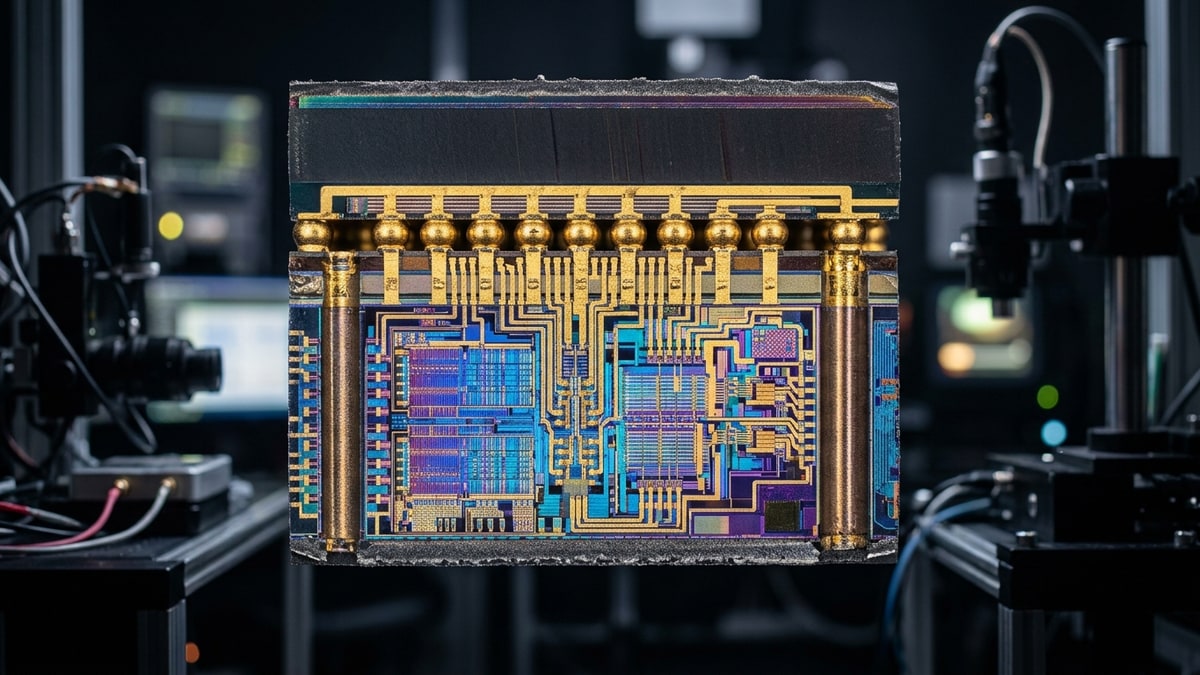
Intel launched its Panther Lake architecture at CES 2026, introducing the Core Ultra Series 3 mobile processor lineup. Manufactured on Intel’s in-house 18A process, Panther Lake succeeds Lunar Lake and Arrow Lake, targeting a scalable range of mobile systems from thin-and-light laptops to higher-performance mobile configurations.
What changed: Intel launched Panther Lake at CES 2026, the Core Ultra Series 3 mobile lineup built on the 18A process with a new tile design and no hyper-threading. Why it matters: The modular tile mix and Arc Xe3 graphics set the baseline for Intel’s next mobile generation, with memory support up to LPDDR5X-9600 and 128 GB. Who should care: Mobile buyers who want the current Core Ultra platform should weigh Panther Lake, with its 16 cores and NPU 5, against waiting for Nova Lake.
Core Architecture and Tile Design
Panther Lake uses a modular tile-based design combining a heterogeneous CPU core tile built on Intel 18A, an integrated graphics tile based on Arc Xe3 architecture (derived from Xe2 Battlemage), and an I/O tile manufactured on TSMC’s N6 process. The platform omits hyper-threading support across all models.
High-power H series processors feature up to 16 cores configured as:
| Core type | Count |
|---|---|
| P-cores (Cougar Cove) | 4 |
| E-cores (Darkmont) | 8 |
| LP-E-cores | 4 |
Low-power variants use an 8-core configuration with 4 P-cores and 4 LP-cores. Non-Arc H series CPUs utilize a larger I/O tile with 20 PCIe lanes (12 PCIe 5.0, 8 PCIe 4.0), while Arc H series and low-power CPUs use a smaller tile with 12 lanes (4 PCIe 5.0, 8 PCIe 4.0). Arc H series CPUs specifically use a binned I/O tile that drops DDR5DDR5. A generation of system RAM (memory); newer and faster than DDR4. support.
Graphics and NPU Specifications
Integrated graphics range from 2 to 12 Xe cores, with peak graphics clocks up to 2.5 GHz. Models with 12 Xe cores are branded as Arc B390 or Arc B370 if paired with memory speeds of at least LPDDR5X-7467; otherwise they carry standard Intel Graphics branding. Some larger GPUGPU. Graphics Processing Unit — the chip that renders the game's visuals; the main driver of framerate and image quality. tile models continue to use TSMC’s N3E process for the GPU tile.
The NPU uses Intel’s NPU 5 architecture, delivering up to 50 int8 TOPS on high-power models. Intel opted for an optimized, smaller NPU rather than a fundamentally upgraded design, offering roughly equivalent performance to the previous generation with improved efficiency.
Memory and Platform Support
Panther Lake supports LPDDR5X-9600 and DDR5-7200 across two channels, with maximum memory capacity up to 128 GB. The successor to Panther Lake will be Nova Lake.
Next read
- For the desktop platform that shares the 18A node, see Intel Launches Arrow Lake Core Ultra Series 2 Processors with TSMC-Fabricated Disaggregated Design and No SMT.
- For the successor that moves to the LGA 1954 socket, see Intel Nova Lake: Upcoming Core Ultra Series 4 Processors.
- For how CPU cache and memory shape the simulation games these laptops will run, see Grand Strategy and RTS PC Builds in 2026: Why 3D V-Cache and Memory Bandwidth Matter More Than the GPU.