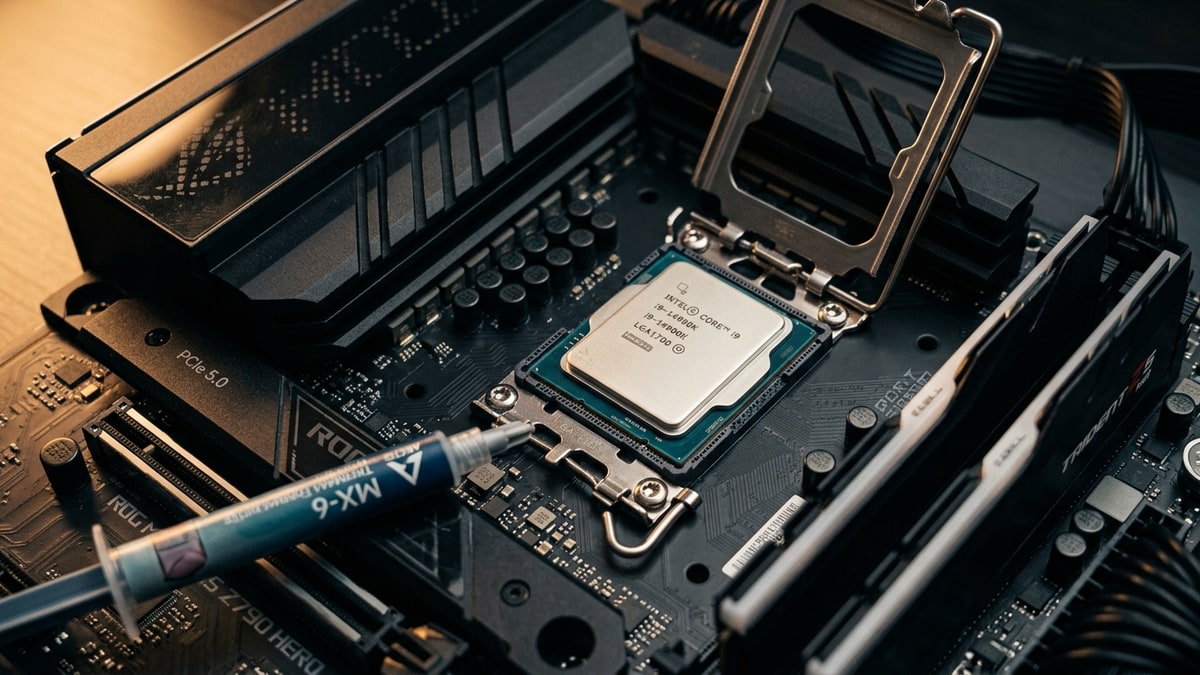
Intel’s Nova Lake represents the Core Ultra Series 4 family of desktop and mobile processors, scheduled for a late 2026 launch. The lineup succeeds Panther Lake on mobile and Arrow Lake across both desktop and mobile segments, with Razor Lake designated as its eventual successor.
What changed: Intel’s Nova Lake is the Core Ultra Series 4 family, built on the 18A process with the new LGA 1954 socket and a late 2026 launch target. Why it matters: The new socket means existing motherboards will not be compatible, and the 18A shift makes this a full platform transition rather than a drop-in refresh. Who should care: Desktop builders planning an upgrade around late 2026 should wait for confirmed core counts, clocks, and pricing before committing to a platform.
Architecture & Manufacturing
Nova Lake is built on Intel’s 18A process node and introduces two new core microarchitectures: Coyote Cove for performance cores (P-cores) and Arctic Wolf for efficiency cores (E-cores). The processors retain the x86-64 instruction set with IA-32 backwards compatibility. Integrated graphics are handled by Intel Arc.
The platform is expected to be the first consumer architecture to support AVX10.1, AVX10.2, and APX instruction set extensions. Additional supported extensions include MMX, SSE through SSE4.2, AVX, AVX2, AES-NI, SHA-NI, RDRAND, SM3, SM4, VT-x, and VT-d.
Platform & Socket
Nova Lake introduces the LGA 1954 socket for desktop platforms. This represents a new physical interface, meaning existing motherboards will not be compatible with the upcoming processors. The desktop and mobile product lines will both carry the Core Ultra branding under Intel’s current naming convention.
Release Timeline
Intel has confirmed that the first Nova Lake processors are expected to launch in late 2026. The platform follows an Arrow Lake refresh also planned for 2026, positioning Nova Lake as Intel’s second major desktop release that year. AMD’s competing Zen 6 architecture is expected to arrive in a similar timeframe.
Market Position
Nova Lake arrives during a period where Intel has publicly acknowledged gaps in its desktop product lineup. The shift to 18A manufacturing and a new socket marks a significant platform transition, placing Nova Lake as a key product in Intel’s competitive roadmap against AMD’s next-generation offerings. Specific core counts, clock speeds, and pricing have not yet been officially confirmed.
Next read
- For the desktop generation Nova Lake replaces, see Intel Launches Arrow Lake Core Ultra Series 2 Processors with TSMC-Fabricated Disaggregated Design and No SMT.
- For the mobile platform that launches before it, see Intel Launches Panther Lake Core Ultra Series 3 Mobile Processors at CES 2026.
- For how X3D cache and DDR5DDR5. A generation of system RAM (memory); newer and faster than DDR4. bandwidth shape late-game strategy performance, see Grand Strategy and RTS PC Builds in 2026: Why 3D V-Cache and Memory Bandwidth Matter More Than the GPU.