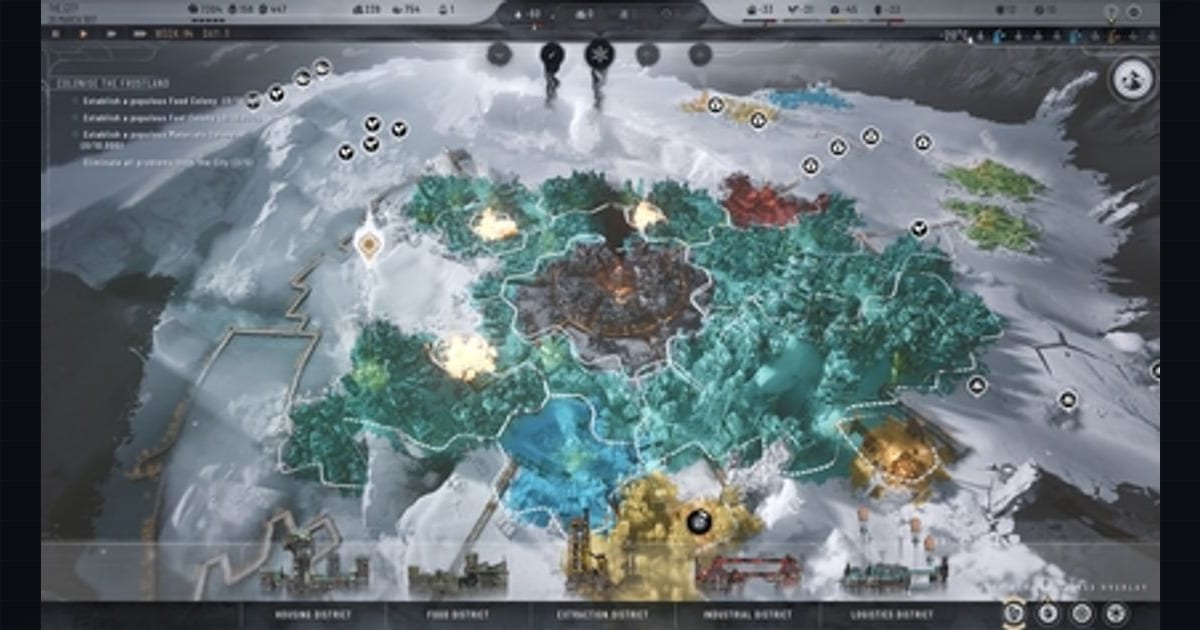
Expanding New London in Frostpunk 2 moves away from individual street building to large-scale hexagonal Districts. Each district—whether Housing, Food, Extraction, or Industrial—demands massive amounts of heat from the central generator. Without intelligent spatial planning and district clustering, your coal and oil reserves will vanish during the first whiteout.
Key Takeaways
- Hexagonal Adjacency Bonuses: Placing districts adjacent to each other provides mutual insulation, reducing heat demand by up to 20 heat per shared border.
- Sheltered Terrain Placement: Building districts inside deep rock valleys or against high cliff walls shields them from freezing northern gale winds.
- Thermal Hub Networks: Overlapping heat hubs extend generator efficiency into distant oil extraction zones without requiring dedicated local generator installations.
District Thermal Efficiency Metrics
| District Type | Base Heat Demand | Optimal Neighbors | Adjacency Savings |
|---|---|---|---|
| Housing District | 40 Heat | Housing, Food Districts | -20 Heat per 3 shared edges |
| Food District | 60 Heat | Housing, Deep Geothermal vents | -15 Heat when sheltered |
| Extraction District | 80 Heat | Industrial Districts | -20 Heat from factory exhaust |
| Industrial District | 100 Heat | Extraction, Logistics | Generates minor heat exhaust to adjacent tiles |
Generator Fuel Transition Strategy
- Early Coal Reliance: Icebreak directly toward nearby surface coal deposits to stabilize basic heating before the first temperature drop (-40°C).
- Oil Pipeline Conversion: Construct logistics districts to reach distant Frostland oil wells. Retrofitting the Generator with an Oil Burner core yields 2.5x more heat output per fuel unit than raw coal.
- Managing Overdrive: Engaging Generator Overdrive temporarily boosts heating by two full thermal tiers during severe whiteouts, but operating above 85% generator stress risks catastrophic structural explosion.
Whiteout Preparation Checklist
Two weeks before a whiteout strikes, pause non-essential production districts, stockpile 10,000 units of food rations, and route all surplus heat into residential sectors to prevent mass illness.
District Heat Levels and Insulation After the 1.3 Overhaul
Frostpunk 2 changed how heating works after launch. The free 1.3 content update reworked heat management “with a focus on locality”: the official 1.3 patch notes state that “Districts now have local heat levels, replacing the global heat demand concept” — a change that supersedes the per-border heat-demand framing used in this guide’s earlier sections — and that each district now runs through “Freezing, Very Cold, Cold, Chilly, Livable, Warm, each with local effects.” The same notes changed how placement effects work: “District proximity effects now apply to one city cell individually; previously, 3 cells were required for the effect to apply.” The publisher’s release frames the rework as a system where “Temperature management now takes place at the district level”, with “new research, laws, and visible consequences” reflecting how warmly or coldly citizens are treated.
Read the temperature overlay first. The Steam page describes the tool the rework is built around: “the Heat Management system with a detailed temperature overlay.” Before buying fuel, use it to spot districts that are being overheated and districts that are still cold.
| Lever | Effect on a district |
|---|---|
| Heat Allocation (Generator) | Raises that district’s temperature; allocation is set per district, not city-wide |
| A Warm district next door | Hands a fraction of a temperature level to each adjacent tile, up to a capped bonus |
| Insulation (researched in the Idea Tree) | Permanently raises a district’s temperature by one level, or two with the upgraded research |
| Heating Hubs and heat laws | Modify a district’s temperature on top of allocation |
Allocation is capped per district. The wiki notes a district can take a maximum of five heat levels from the Generator, with extra levels available only in The City once Progress Generator upgrades are researched. That cap is what turns a fuel shortage into a prioritisation problem: you cannot pour heat into every district at once. The official 1.4.0 notes also warn that the balance changes affect pre-1.3 saves, so returning players may find that heat bonuses they relied on now resolve differently.
Insulation is the permanent fix. Once Insulation is researched, a district can be insulated for 50 Heatstamps and 50 Prefabs. The base upgrade adds one full temperature level, and the upgraded research pushes that to two levels for no extra construction cost, applying retroactively to districts that were already insulated. The official hotfix notes for 1.4.0 confirm the mechanic is tracked per district, listing a fix for the “District Insulation bonus not applying if upgrade was completed on turned-off district.”
Heat-sharing chains. A Warm district hands part of a temperature level to every neighbouring tile, up to a maximum, so a row of adjacent warm districts warms one another. The wiki describes a chain in which each district pulls the next up, and the second district feeds heat back into the first, so the whole chain can hold its temperature while consuming less Generator allocation. That is the post-1.3 version of the cluster-your-districts idea, with the pay-off now expressed as temperature levels.