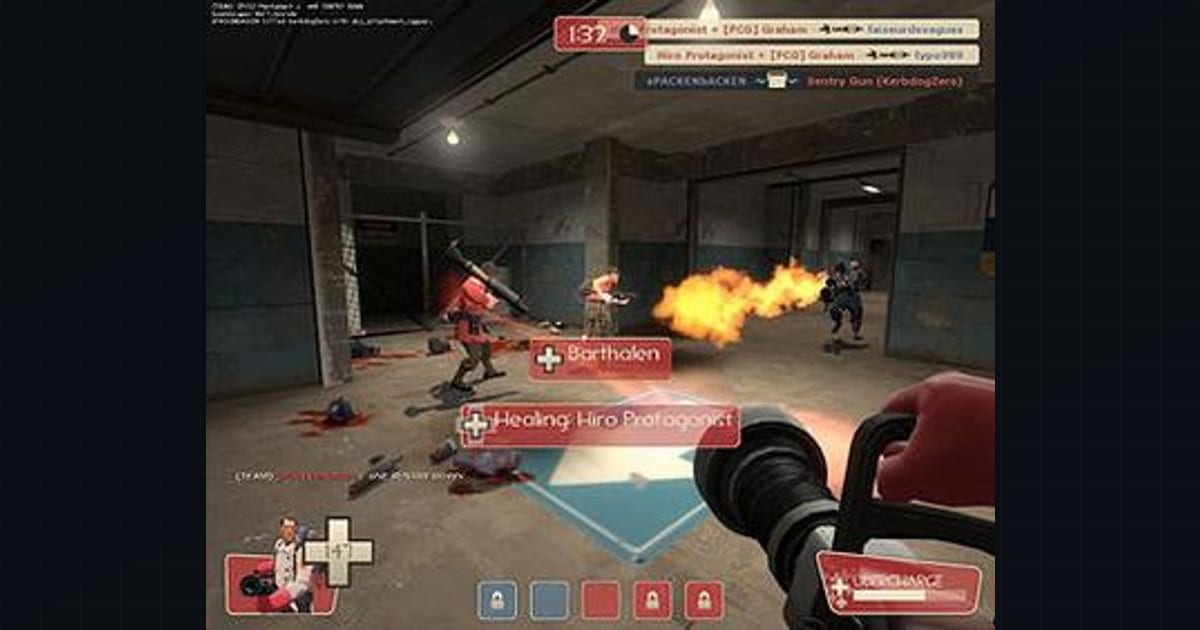
Team Fortress 2 released on 10 October 2007 and sat 27th on Valve’s most-played chart for 11 November 2026 with a 100,175 peak. The reason it is still there is not the hats and it is not nostalgia: it is that the nine classes are nine different movement-and-timing games sharing one map, so a lobby of twelve players is never really playing one game.
What this is: a starting filter for the class question, built from the official class documentation rather than from tier lists. Why it still matters: the game is free, the ceiling is high, and the class you pick decides what you spend your first hundred hours learning. What it is not: a loadout guide. Unlocks change what a class can do; they do not change what it owes the team.
The nine, by what they actually do
Valve’s own documentation sorts the roster into three combat types, and that grouping is the most useful thing on the page: it tells you what failure looks like for each class.
| Class | Group | Health | What it owns |
|---|---|---|---|
| Scout | Offensive | 125 | Capture points twice as fast as anyone else, and arrive first to do it — top-tier speed plus a double jump |
| Soldier | Offensive | 200 | Rocket launchers, and the ability to attack from directions the map does not have, via rocket jumping |
| Pyro | Offensive | 175 | Ambush, and extinguishing burning teammates; the documentation calls it the best speed-to-health ratio of the nine, barring buffs or non-standard equipment |
| Demoman | Defensive | 175 | Area denial with stickybombs he detonates on his own timing |
| Heavy | Defensive | 300 | Sustained fire that pushes a push back, and enough health to stand in it |
| Engineer | Defensive | 125 | Sentry guns, teleporters and dispensers: area defence plus the team’s logistics |
| Medic | Support | 150 | Mobile healing, overheal to 150% of a teammate’s maximum, and four different buffs |
| Sniper | Support | 125 | Removing one specific player from the fight, at range, before the fight starts |
| Spy | Support | 125 | Infiltration: disguise, building sabotage, and the backstab |
Two things fall out of that table immediately. The support group is not the easy group — Valve’s documentation is explicit that Medic, Sniper and Spy “cannot hold the fight on their own”, which is a strange thing for a game to admit about three of its nine classes and a useful warning about how they are played. And health is not toughness: the Engineer has 125 health, the same as the Scout and the Spy, and what he adds to a team is not health but infrastructure.
Health, overheal, and the honest number
The health column is the fastest way to understand why a class feels the way it does. The numbers are why a Soldier can afford a face-to-face exchange and a Scout usually cannot. Overheal raises the ceiling for everyone: a Medic can push a teammate to 150% of their maximum, and the wiki’s own table puts that at 300 health on a Soldier and 185 on a Scout. The Quick-Fix overheals only to 125% instead of 150%, and can still maintain a full overheal another Medi Gun created.
That distinction is the whole reason a Medic’s choice of Medi Gun is a strategy decision and not a preference. Overheal is the resource that lets a 125-health class take a fight it would otherwise lose, and how much of it you can hand out decides which classes on your team become viable at the front.
Speed is the other half of the class
Valve measures speed in velocity units, with the standard set at 100% — the Engineer, the Pyro and the Sniper. The Spy moves at 107%. Forward speed caps at 173%, crouched movement is a third of forward speed, and backward movement is generally 90% of forward speed.
Three consequences worth knowing before your first hour:
- Backpedalling is a trap. Backward movement is generally 90% of a player’s own forward speed, so a retreat is a slower movement than the advance that started it — and the most common new-player death in the game is walking backwards into someone who is not.
- The Spy’s speed is honest. A Spy disguised as a slower class genuinely slows to that class’s speed, but disguising as the Scout does not make him faster — he stays at 107%. The disguise changes what enemies see, not what the Spy can do.
- Capture rate is not shared. The Scout’s doubled capture rate is the one objective ability no other class has, and it is why a Scout who spends the match fighting has given up the thing that cannot be replaced by another class.
Choosing, by temperament rather than by tier
Tier lists answer “what is strong in this meta”. A new player needs “what will teach me the game”, and those are different questions.
- If you want to learn map geometry, play Soldier. Rocket jumping forces you to read the map as a set of surfaces rather than corridors, and 200 health forgives the mistakes that come with that.
- If you want to learn positioning, play Medic. Nothing punishes bad positioning faster, and nothing teaches you where a team should be standing like being the player everyone is trying to kill.
- If you want to learn timing, play Demoman. Stickybombs are a bet placed seconds before the result, and there is no other class where the gap between decision and consequence is that wide.
- If you want to learn the enemy’s habits, play Spy. Disguise and cloak make you read what other players notice, which transfers to every other class you play afterwards.
- If you want to learn to hold a line, play Heavy. The class with 300 health is the game’s tutorial in when to stand and when to leave.
Two warnings that are documented rather than opinion. Demoknight is the only subclass — a specific weapon set that changes how a class is played, not a ninth-plus class, and it teaches a different game than the one the rest of the roster shares. And the Random option exists for exactly the reason a new player needs it: Valve’s own page recommends it as a way to get familiar with the characters, which is a strong hint that the class question is not answerable from a description.
Where the game actually lives
Nineteen years of updates have left TF2 with a patch cadence that is still real, and its Scream Fortress event has reached eighteen editions — the 2026 one is documented on this site, with five community maps and a 23-item case.
The practical consequence for a new player is that the server matters more than the class. Casual queues and community servers teach different games, and the class that feels weak in one can be strong in the other because the fight sizes differ. Pick a class, then pick a server type, then decide — in that order.
What cannot be said honestly is which class will make you good. The documentation describes abilities; it does not describe the player. What it does describe, precisely, is what each class is for — and that is enough to stop you spending a hundred hours on the wrong one.