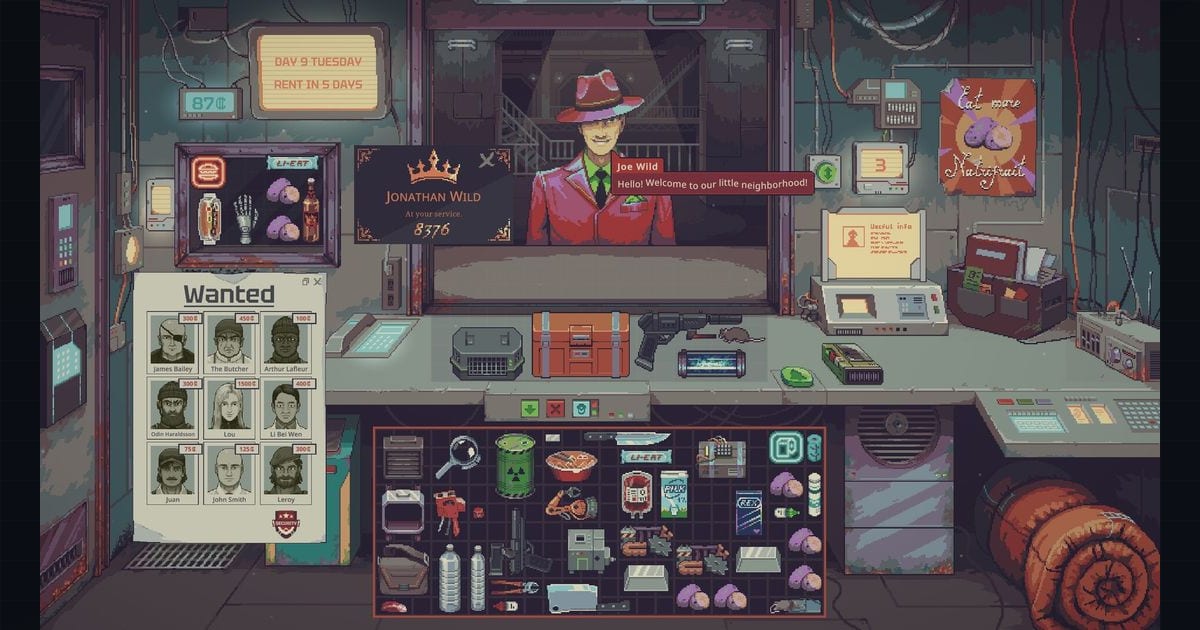
On 14 November 2026, Probably Stolen costs $19.99 and is no longer discounted: Steam’s price API returns discount_percent: 0 for the US store, where the launch window ran at 10% off. The store page shows 95% of 5,386 reviews positive. The question this piece answers is narrower than a build order — which numbers in this shop sim are actually written down, and what can you compute from them without inventing a thing.
The answer is that the patch notes price three machines, one battery and a handful of multipliers, and set two reputation thresholds without putting a price on a point. That is enough for real arithmetic: the water kit’s total cost fell 37.5% before the first balance patch was a fortnight old. It is nowhere near enough for a per-item profit table. Where the game withholds a number, this article says so rather than filling the gap. Our primer on the same shop loop covers what the verbs mean; this one covers what they cost.
What this covers: the arithmetic the patch notes support — three machine prices, two reputation thresholds that waive a fee, one item whose value is a formula, and the tag classes that decide which customer walks in. Why it matters: the water chain was repriced twice in two days and the item classes were re-cut twice, so any launch-week maths on this game is already wrong. What it is not: a per-item margin table. Apart from Disposable Batteries, the notes publish no item values, no rent schedule and no machine yields, and none are invented below.
Patch state, and the numbers in it
The newest numbered changelog I could fetch is “Cumulative Update - 1.0.0.12”, posted 6 November 2026. The hotfix after it, posted 8 November, is titled “100-Rev13 Hotfix”, and its contents — a Chinese translation rollback, a fix for items in Lou’s locker being miscounted in a way that “caused the player to be bombed”, and a notice that a modding security update “will be fully merged on December 10” — carry no balance numbers at all.
So every figure below comes from 1.0.0.1 through 1.0.0.12, plus the open-playtest patches that preceded launch. Write “as of 1.0.0.12” beside any number you repeat, because 1.0.0.5 exists mainly to finish the previous job: the Water Purifier’s cut “was missed in the last patch” and only landed on 30 October, two days after 1.0.0.2 rewrote machine prices.
That patch history is why this article is arithmetic rather than advice. A guide quoting a Moisture Farm at 650 was correct for the first ten hours of the game’s life; 1.0.0.2 landed the same evening as launch.
The water kit: three prices, one decision
The three water machines are the only production chain whose full price is on the record.
| Machine or price | Before | After | Where it changed |
|---|---|---|---|
| Moisture Farm | 650 | 350 | 1.0.0.2, 28 October |
| Water Filter | 50 | 25 | 1.0.0.2, 28 October |
| Water Purifier | 300 | 250 | 1.0.0.5, 30 October |
| Dr. Jackson’s markup on his stock, Normal | 25% | 15% | 1.0.0.2, 28 October |
| Disposable Battery | — | 1 Credit + 1 Credit per 3 kJ of charge | 1.0.0.12, 6 November |
| Lou’s demand after her disguise visit | one figure* | 500 / 750 / 1000 / 1500 Credits on Cozy / Normal / Hard / Challenge | 1.0.0.12, 6 November |
| Eleanor’s bail | — | 500 Credits, or vouching free at 40 Security reputation | 1.0.0.12, 6 November |
| Georgio leaving Serpico’s food for you | — | 150 Credits, or free at 40 Lower Levels reputation | 1.0.0.12, 6 November |
| Janitorial service at −40 Black Market reputation | standard | doubled cost, access retained | Playtest 48.3.10 |
*The note says her demand “now depends on the difficulty”, which implies it previously did not; the old figure is not stated anywhere I could fetch.
The Moisture Farm’s cut is 46.2%: (650 − 350) / 650 = 300 / 650 = 0.4615. The Water Filter halved outright. The Water Purifier’s cut is 16.7%: 50 / 300 = 0.1667.
What matters is the set, not the parts. A Moisture Farm plus a Water Filter plus a Water Purifier cost 1,000 Credits at launch (650 + 50 + 300) and 625 by 30 October (350 + 25 + 250). That is 375 Credits off the kit, or 37.5% (375 / 1,000). The two expensive pieces also converged: a farm cost 2.17 Purifiers at launch (650 / 300) and 1.40 now (350 / 250), a 35.4% compression of that ratio ((2.167 − 1.40) / 2.167).
One ratio moved the other way. Measured against the cheapest component, the farm got relatively dearer: 650 / 50 = 13 filters per farm before, 350 / 25 = 14 after. Both prices fell; the filter fell slightly harder.
What none of it gives you is a payback period, because no source states what a bottle of water sells for. The only production figure in the notes is the one a patch deleted. 1.0.0.12 fixed “the Moisture Farm producing at most 6 L a night, even when its output was higher and the container had room” — that 6 L was the bug, not the yield. Do not build a break-even on it.
The one item with a formula
Batteries are the only stock whose price the notes express as a function: “Disposable Batteries now sell for 1 Credit plus 1 Credit per 3 kJ of charge, and count as low-level contraband” (1.0.0.12). Read literally, value = 1 + charge / 3.
| Charge held | Value under the formula |
|---|---|
| 3 kJ | 2 Credits |
| 6 kJ | 3 Credits |
| 9 kJ | 4 Credits |
| 12 kJ | 5 Credits |
The marginal rate is 1 Credit per 3 kJ, or 0.333 Credits per kJ. The note does not say how a partial 3 kJ rounds, so the table stops at exact multiples.
Two consequences for a display. First, a charged battery and a flat one are different products in the same footprint: at 12 kJ the formula returns five times what it returns at zero (5 / 1). Second, the label does not scale with the value — a 5-Credit battery is still “low-level contraband”, so the classification stays the same while the sale value rises. The notes give no risk function and no purchase price, so this is a sale-value formula, not a restocking margin. It is still the one number here you can compute rather than feel.
Classes are tags, and the tags pick the buyer
The patch notes never use the word “tier” for stock. They use tags, and each tag is a demand filter.
| Class | What the notes say it does | Patch |
|---|---|---|
| Material | Energy cells in the display case “now count as Material: they attract material buyers, and their value helps reach the better material customers” — but “they do not have the Material tag” | 1.0.0.12 |
| Water | Premium Spring Water “now has the Water tag, but non-Upper Level customers and tourists will not accept it” | 049 |
| Household | Water containers count as water goods only while holding liquid, “and as household goods when empty”; the water pitcher is “also classified as a Household Item” | 049 |
| Contraband (low-level) | Disposable Batteries “count as low-level contraband” | 1.0.0.12 |
| Tool | “The Current Converter now counts as a Tool” | 1.0.0.12 |
The Material row separates two things the interface otherwise blurs: what a buyer is attracted by, and what an item is. Energy cells attract material buyers, help reach better material customers, and are still not tagged Material — so attraction and membership are tracked separately. Water is the mirror case: a tag can exclude buyers (“tourists will not accept it”) rather than add them.
The buyer side moved in the same window, mostly by bug fix. Variety buyers and tourists now apply their price bonus to items “that were already on the counter when they arrived” (1.0.0.12); “premium and discount buyers no longer apply their modifier twice to boxed contents” (049); “some T3 buyers from the display case now scale their budget” (049). Only one of those three removed double-counting, so any guide written before 6 November that promises a stacked box bonus is describing arithmetic the patch deleted.
Where theft risk is charged
Risk in this game is charged through objects, not through a visible meter.
The supply of stolen goods is a function of standing: “The Thief’s stock now scales with Black Market reputation” (049). The defence is a machine with a number attached, and a floor under it: “The Security Alarm’s theft prevention rate can no longer go below 0” (049) — a negative rate was possible, which is worse than owning no alarm.
Storage is the failure point. 1.0.0.1 fixed items inside a Smuggler Bay “being confiscated during inspections when the bay was in the trash can, or (for the Mini Smuggler Bay) after it had been kept behind the poster”, and 1.0.0.5 stopped the Smuggler Bay Mod itself being “thrown out with the trash if you leave it in the trash can overnight”. The bay was never the risk; its position was.
The most expensive change is the one that removed free reputation. Playtest 48.3.12 (7 August) states: “A cleared inspection that resulted from showing contraband in the display case will no longer grant Security reputation.” The note names the exploit it closed — players farming “free Security reputation by repeatedly displaying contraband and then hiding it in the smuggler bay to pass inspection”. What the note closes is that one loop and nothing else: displaying contraband to earn a cleared inspection no longer pays Security reputation, and the note says nothing about contraband’s sale value.
Which brings the display case back to pricing. The store page is plain about the trade: you can “fence discounted, stolen goods if you believe Security won’t reach you”, contraband “brings raids”, and the feature list offers to “hide stolen goods and contraband from the authorities (or bribe your way out if you get caught)”. The Fence start is summarised in five words: “Stolen goods. Move fast, stay invisible.”
Two patch notes then waive a payment for reputation, which is not the same as pricing it. Eleanor’s bail is “pay 500 Credits, or vouch for her for free with at least 40 Security reputation”; Georgio’s offer to leave Serpico’s food is “150 Credits”, or free “as a favor if you have at least 40 Lower Levels reputation”. Both thresholds are 40, they sit in different ledgers, and neither note says a point is spent or exchanged. What the record supports is narrow: reaching 40 saves 500 Credits against one payment and 150 against the other. It states no rate, and nothing that ranks one ledger against the other.
Negative standing is a multiplier before it is a wall. At −40 Black Market reputation the janitorial service stays available, but “the cost is doubled” (playtest 48.3.10) — 2×, with access intact.
The multipliers, which are the other half of the price
Machines are not the only thing the notes quantify. Perks and upgrades carry explicit before-and-after values, and most are multiplicative.
| Change | Before | After | Effect |
|---|---|---|---|
| Model Citizen perk: credit bonus for reporting criminal customers | 20% | 50% | 2.5× the bonus (50 / 20) |
| Intimidating perk: evidence generation reduction | 25% | 33% | 1.32× the reduction (33 / 25), and its starting cost fell 3 → 2 |
| Addiction perks: trading penalty | 5% | 8% | 60% larger penalty (3 / 5) |
| Lucky / Unlucky perks: luck swing | ±5 | ±15 | 3× the effect, new runs only |
| Power Line Hijack: Current Converter running cost | standard | 15% cheaper, and they run during blackouts | tiers II and III cheaper still, no figure given |
| Dr. Jackson’s markup, Normal | 25% | 15% | at equal base cost, 1.25× became 1.15× — 8% cheaper (0.10 / 1.25) |
| Janitorial service at −40 Black Market | standard | doubled | 2× |
The perk row worth watching is Intimidating: 1.32× the effect for two-thirds the price, the only case in these notes where a buff and a cost cut arrived together. Addiction perks went the other way — the penalty grew 60%, and the starting item the patch hands you with them is not quantified.
When to expand instead of restock
The sources support two expansion rules and no more, so treat these as consequences of stated numbers rather than a strategy.
Buy the kit, not the part. The full water chain is 625 Credits today against 1,000 at launch; the two-machine core, farm plus purifier, is 600 against 950 (650 + 300), a 36.8% cut (350 / 950). Every component sits at its lowest recorded price.
Do not over-commit to a class the roadmap is about to change. The free-updates post of 12 November is the only forward signal in the sources: mid-December brings a Junker starting scenario with “a Junker-related starting perk and new items”, Expeditions (“hire, equip and send scavs on expeditions”), “a minor Fence expansion”, and — “likely” — a gunsmith expansion “adding shotgun shells, 25mm grenade rounds and a tier 3 handmade SMG” plus armor. Late January is the Organ Dealer scenario, with organs and blood, where “different blood types will have value modifiers”. April is the Street Food Vendor. The 6 November roadmap post states that every update on it is free and that the plan covers six months.
Four of those updates add item classes: shells, grenade rounds, organs, blood, food. Whether those classes gain suppliers or new buyer types is inference rather than a roadmap statement, and no class margin can be computed from the announcement.
What the player numbers do and do not prove
| Figure | Value | Source and date |
|---|---|---|
| Copies sold, first few hours | 200,000 | Studio post, 28 October |
| Copies sold, first 24 hours | 350,000 | Studio post, 29 October |
| Peak concurrent, day one | 112,000+ | Studio post, 29 October |
| Copies sold | 500,000 | Studio post, 30 October |
| Peak concurrent | 186,095 | SteamDB, 8 November |
| “Shopkeepers” | 1,000,000 | Roadmap post, 6 November |
| Reviews at fetch | 95% of 5,386 (Metacritic: 74) | Steam store page and appdetails API, 14 November |
The peak grew after launch rather than decaying: 186,095 against a day-one figure of 112,000+ is about a 66% increase (186,095 / 112,000 = 1.66). The studio’s ”+” makes 112,000 a minimum, so a higher true baseline would make that increase smaller — 66% is an upper-bound estimate, not a floor.
Two figures deserve suspicion. The studio’s 6 November post celebrates “1 MILLION Shopkeepers” — people, after 500,000 units on 30 October — so it is not a second sales milestone. And 350,000 copies at the launch price of $17.99 is $6.30 million of gross list value (350,000 × 17.99 = 6,296,500) before Steam’s cut, regional pricing and bundle discounts. That is a list-price figure, not revenue.
What is still not priced
- Item sale values. Apart from the battery formula, the cited notes publish no item sale-value table and no source states what a bottle of water or a stolen item sells for, so margin per item class cannot be computed from the record. Every derived percentage here is about cost, never profit.
- Rent and the buy-out. The store page says rent keeps rising and the ending is buying the store from the landlord; neither has a figure.
- Machine yield. The only litres-per-night number in the notes is the 6 L cap that 1.0.0.12 removed as a bug.
- Difficulty multipliers. The four options are named only through Lou’s demand (Cozy 500, Normal 750, Hard 1000, Challenge 1500); their general effect is not documented.
- Appraisal and licence prices. The sources name an Appraisal Certificate window, “advanced licenses to access the underground market”, and a revoked Weapon Permit 1 that lets you keep the shotgun — but state no prices for any of them.
The practical read: this game prices costs far better than it prices returns. Build your costs out of the numbers that exist — 625 for the water kit, 1 Credit per 3 kJ of battery charge — and refuse to guess the rest.
Next read
- Probably Stolen: Cyberpunk Shopkeeper Sim Primer — the loop, the nine starts and the systems in the game’s own words.
- Tempest Rising Economy Guide: GDF vs Dynasty Harvesting — the same judgement about supply and demand, at macro scale.
- Euro Truck Simulator 2 1.61: Volvo 100 Year Edition — the other business sim on this site where cost per run decides the route.