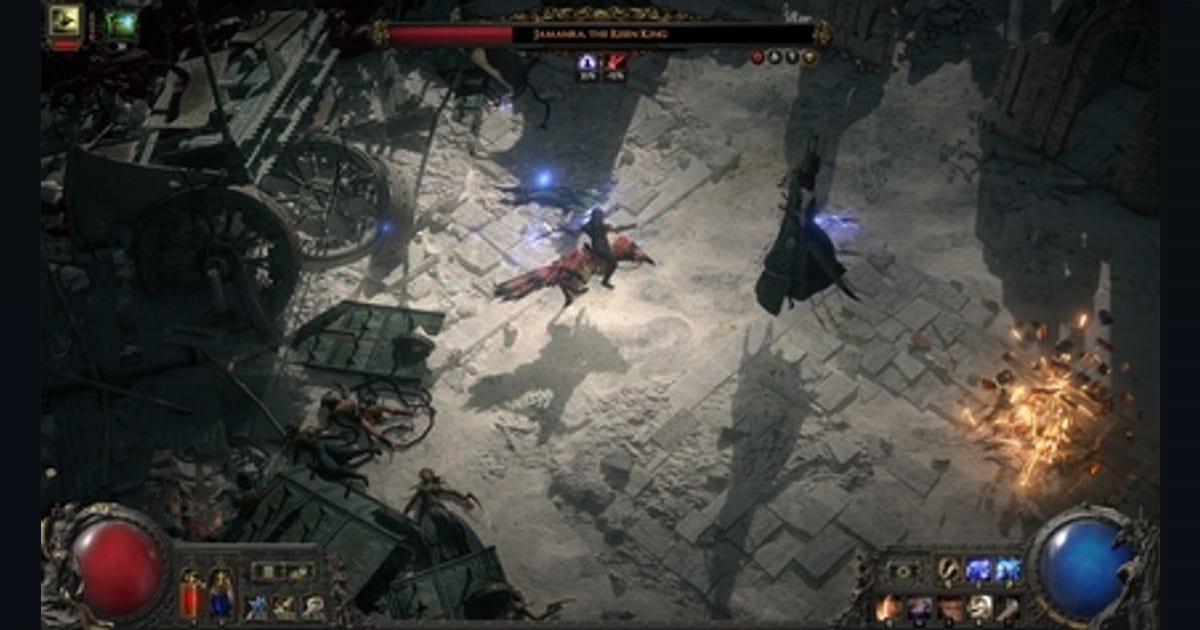
Boss encounters in Path of Exile 2 have evolved from the bullet-hell stat-checks of PoE1 into deliberate, Souls-adjacent mechanical duels. With the universal addition of an unmetered dodge roll and a dedicated stagger posture meter beneath every boss health bar, understanding attack tells and animation recovery is the key to conquering endgame Pinnacle bosses.
Key Takeaways
- Universal Dodge Roll: Spacebar triggers an omni-directional dodge roll with 12 invulnerability frames (i-frames) at the start of the roll, capable of canceling weapon backswing animations.
- Stagger Posture Bar: Heavy blunt hits, freeze buildup, and stun damage accumulate on an internal posture bar; breaking it collapses the boss into a 4-to-6 second vulnerable state.
- No Checkpoint Reset Cheese: Boss health does not reset upon player death inside campaign arenas, but bosses regain ward shields and summon additional guardian phases.
Boss Stagger Mechanics and Damage Windows
Every major boss in Path of Exile 2 features a secondary white posture bar positioned immediately under their main health bar.
| Combat Phase | Boss Behavior | Optimal Player Action |
|---|---|---|
| Neutral Phase | High armor, full attack cycle active | Apply damage-over-time, build posture with heavy skills |
| Warded Phase | Energy shield barrier absorbs damage | Use shield-break elemental triggers (Lightning / Cold) |
| Stagger Collapse | Incapacitated for 4–6 seconds | Unleash full multi-link burst skills and cooldown rotations |
| Enrage Transition | Arena floor hazards, attack speed +25% | Prioritize defensive positioning and dodge roll timing |
Dodge Roll Mechanics and Hitbox Clearance
The dodge roll in PoE2 is unencumbered by stamina meters, but spamming rolls introduces diminishing recovery speed.
- Initial i-Frames: The first 0.2 seconds of the dodge roll grant full invulnerability against direct strikes and projectile hits.
- Ground AOE Exceptions: Lingering ground damage over time (degen pools, burning ground, poison clouds) still deals damage during a roll—rolls must be aimed away from hazard patches rather than through them.
- Collision Clearance: The roll sets the character’s size to zero units, letting it get through even the smallest gap between monsters and push some smaller monsters; it still cannot phase through monsters, so a dense pack can still body-block.
High-Threat Boss Tell Identification
Watch the boss’s primary weapon hand and vocal audio cues. Attacks that telegraph with a red glow and an audio cue during the windup indicate unblockable strikes that must be evaded rather than guarded with shields.
Stagger and Dodge Windows After the 0.2.0 Patch Cycle
This guide’s systems have not been static. Grinding Gear Games changed both how much space the dodge roll occupies and the rules around the stagger and Heavy Stun bar after Early Access launched.
The dodge-roll change is about space, not immunity. The 0.1.0d patch notes state: “Player size is now set to Zero units while dodge rolling instead of One unit.” The same patch adds: “Some smaller monsters can now be pushed while dodge rolling. This includes monsters such as the Adorned Beetles in Keth.” Neither bullet adds invulnerability frames; what changed is the space the character occupies and which smaller enemies yield. That patch also fixed a stagger-trigger bug: “Fixed a bug which caused enemies to be Primed for Stun or Electrocute earlier than intended while in a party.”
The stagger rules were then reworked in the 0.2.0 Dawn of the Hunt update. Its player-facing changes include: “Unified stun mechanics and terminology between players and monsters. The ‘stagger’ that players suffer when blocking too much damage with their shield raised is now a heavy stun.” The posture bar this guide calls a stagger is therefore now the Heavy Stun bar on both sides of the fight. The update also lowered the buildup at which enemies become Primed for Stun — the state in which a Crushing Blow effect finishes the bar and forces the collapse:
| Monster rarity | Primed before 0.2.0 | Primed in 0.2.0 | | Magic | 60% | 50% | | Rare | 70% | 60% | | Unique | 80% | 70% |
GGG shipped the identical reduction for the Primed for Electrocution thresholds. Ten fewer points of buildup means a unique boss reaches its punish state sooner, so the payoff arrives with less setup than at launch.
The counterweight sits on the boss. Under Monster Changes, 0.2.0 adds: “Bosses that need to perform certain actions to progress their fight will now become immune to damage if their life is brought significantly past the point at which that action should be used.” GGG’s stated intent is to “prevent cases where bosses could get semi permanently crowd controlled and prevent the fight from progressing.” A stagger window is therefore not a licence to erase a scripted phase; the encounter’s action still has to play out before the boss is vulnerable again.
The patch changed what happens when the boss wins the exchange, too. Your Heavy Stun bar now “doesn’t start emptying until the Heavy Stun animation has finished (instead of when the Heavy Stun animation starts),” player Heavy Stun duration rose to “3 seconds (previously 1 second),” and “Players cannot Block or Evade Hits while they are Heavy Stunned.” Blocking or parrying a hit does, however, now give “a chance to avoid accumulating heavy stun buildup equal to the chance you would otherwise have had to evade the hit,” so a shield or buckler is a real answer to the bar.
Two damage-window numbers moved in the same patch: “Freeze now builds up roughly 48% slower on enemies,” and “Armour on all monsters has been reduced by 30%.” Freeze-based setups reach their payoff more slowly, while physical hits chew through less mitigation before a window opens. Finally, 0.2.0 named two boss attacks that cannot be blocked — “Count Geonor’s 180 degree Swipe attack can no longer be blocked” and “The Bloated Miller’s shield charge can no longer be blocked” — and fixed one the guide’s advice assumes should work, noting that a boss’s “Lightning Lance skill used by Brutal Transcendent enemies could not be blocked or dodge rolled.” The unblockable list is a moving target, so check current notes rather than a launch-era tell.