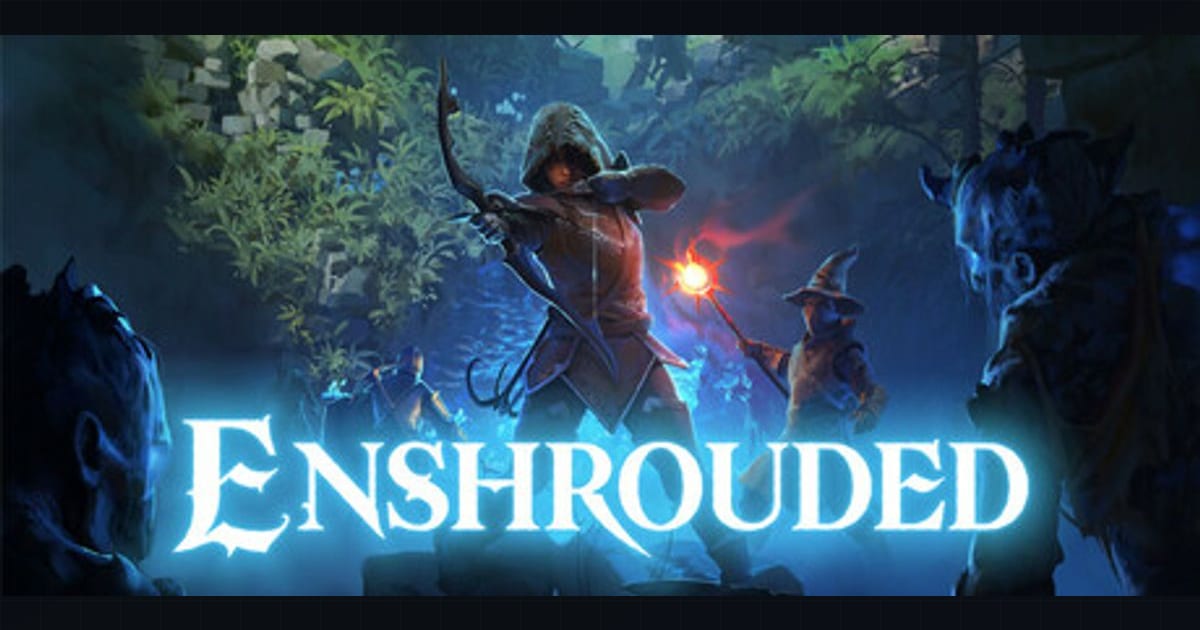
Enshrouded left early access on 15 October 2026 and has taken five patches in the nineteen days since. That alone is the reason this page exists: the beginner advice that circulated during early access describes a different build, a different opening act and, in a few places, a different world. What follows is the orientation layer — what the game asks of you in the first session, which systems decide how fast everything else opens, and which of this site’s deeper guides to open when you hit a specific wall. Every claim below assumes patch 1.0.1.1 (build 1285601, released 3 November 2026), the current public build on Steam at the time of writing.
What this covers: a start-here route through Enshrouded 1.0 — the four first-session decisions, the Shroud timer, what the 1.0 rework changed for a fresh save, and the two post-launch patches a new run will actually feel. Why it matters: 1.0 reworked the early-game recipe curve, added loot to the starting biomes and changed bosses, so old level-one advice is now misleading rather than merely stale. Who should care: players starting fresh, returning players importing an early-access save, and anyone trying to judge whether the first ten hours are worth $39.99.
What Enshrouded is, in one screen
It is a survival action RPGRPG. Role-Playing Game — a game built around character progression, story, and player choices. from Keen Games, played alone or in co-op for up to 16 players, set in a hand-crafted voxel world called Embervale. That word matters: the world is authored rather than procedurally generated, so the landmarks, dungeons and vertical routes are the same for every player. Steam lists it as an action/adventure/RPG release rather than a pure survival game, which matches how it plays: the crafting and building are the substrate, but the progression is level-gated combat and questing.
The world’s defining hazard is the Shroud, a fog that has swallowed most of the kingdom. Standing in it starts a timer at the top of the screen; running out kills you. Your base is a Flame Altar, and the survivor NPCs you rescue from the fog staff the crafting stations that unlock each tier of gear.
| Item | Value | Where it comes from |
|---|---|---|
| Public build | 1.0.1.1 (build 1285601), 3 November 2026 | Hotfix #4 changelog |
| Launch | 15 October 2026 | Steam app-details API |
| Price | $39.99, no discount at time of writing | Steam app-details API |
| Platforms | Windows PC at launch; no cross-platform play, no estimate for it | Steam app-details API; Launch FAQ |
| Player level cap | 50 | 1.0.0.0 changelog |
| Gear upgrade cap | 55 | 1.0.0.0 changelog |
| Co-op | Up to 16 players | Steam store description |
| Steam recommendations | 99,321 | Steam app-details API |
The first hour: four decisions that compound
The opening of 1.0 is deliberately gentler than early access was, but it is not directionless. Four things happen in the first ninety minutes that set the pace for the next twenty hours.
1. Plant the Flame Altar. The altar is crafted through Manual Crafting from five units of any stone, and the recipe unlocks when you accept the quest Claim A Spot For Your Base. Until it exists, nothing you build is permanent: the wiki states that changes made inside the altar’s boundary persist, while changes outside it reset after 30 minutes or on a game restart. The altar also serves as a fast travel point, a heat source for resting buffs, and the place where you reset your skill tree at a cost of one Rune per spent skill point.
2. Climb the Springlands Ancient Spire. Spires are teleport structures built by the Ancients, and each one is a climbing puzzle. At the top, speaking with the Flame reveals the Ancient Obelisks in that biome; interacting with an obelisk then reveals Shroud Roots and Flame Shrines in the same area. That chain — spire, obelisk, root — is how the map gets filled in, and it is also how you unlock fast travel. Skipping it does not block you; it just makes every later trip twice as long.
3. Spend skill points on purpose. Points come from three sources: two per character level, one per Shroud Root, and three per Elixir Well, according to the wiki’s skills page. Each root and well only pays out once, whatever the world does on restart. Any class can walk down any pathway so long as the nodes connect, so a first character can be a hybrid without penalty — and the altar’s Rune-priced reset means a misallocation is recoverable rather than fatal.
4. Strengthen the Flame before you go north. Flame upgrades raise your attributes, extend Shroud time and raise the Shroud Passage level that opens red Deadly Shroud regions. The full ladder, including the ingredient lists at each level, is a separate guide — see the routing table below rather than duplicating it here.
| Priority | First-session action | Why it pays | Deeper detail |
|---|---|---|---|
| 1 | Craft and place the Flame Altar | Makes building permanent, opens fast travel and skill resets | Flame Altar and Shroud Passage guide |
| 2 | Climb the Springlands Ancient Spire | Reveals obelisks, then Shroud Roots and Flame Shrines; unlocks travel | Flame Altar levels and Ancient Spire travel |
| 3 | Spend the first 6–8 skill points down one connected path | Attributes matter more than gear at this stage | Wiki skill-point sources |
| 4 | Push the Flame to the level your biome requires | Removes the Deadly Shroud penalty from the next region | Altar and Shroud Passage guide |
| 5 | Rescue the Blacksmith and Alchemist | Their stations open melee and magic gear plus potions | Wiki survivors page |
The Shroud timer is the actual difficulty slider
New players tend to read the Shroud as weather. It is closer to a fuel gauge. Normal Shroud starts a countdown; Deadly Shroud, marked by red fog, drains that countdown much faster, and the wiki is blunt that entering it is not recommended until your Flame level covers the region. Hazards can convert ordinary Shroud into the deadly variety — an exploding puffball is enough.
Three things reset the clock in practice. Save points inside the fog restore Shroud time while you stand near them, hourglass capsules add time (the 1.0.0.0 changelog puts the gain at about 70% more), and large Fell enemies now drop capsules after a long fight. Upgrading the Flame also reduces how much Deadly Shroud exists in the world, which is the real reason the upgrade ladder matters more than any single piece of gear.
What 1.0 changed that a fresh run will feel
The 1.0.0.0 changelog is enormous, but only a handful of its entries change the opening hours.
- Recipes were reworked, especially early. Keen Games states the goal was to reduce the grind and get players to the better crafting tiers faster.
- The starting biomes got more loot. More chests were added to Springlands and Revelwood, wooden chests can now roll a weapon or armour piece at silver-chest level, and gold coins appear in chests across Embervale as a survivor currency.
- Building became less fussy. A new skill allows free-flying construction, storage chests can be upgraded in place without emptying them, and most areas previously marked as no-build zones are now open for bases.
- Picking things up changed. Scattered loot can be collected in a larger radius, either on a held button or automatically via a gameplay setting — with containers, enemy drops and quest items excluded.
- Comfort now feeds stamina. Resting in a sheltered spot with comfort items grants the Rested status, and each comfort level adds a minute of rested time; the altar itself provides one comfort by default. The wiki flags a reported bug where the per-level value does not match that one-minute rule, so treat the numbers as directional.
- The mage fantasy changed shape. Nine new spells arrived, including summons and area attacks, every spell has an Eternal variant that consumes no charges, and Eternal spells can now be upgraded with perks. Wands gained a heavy attack that pierces and interrupts, plus aerial and evasion attacks.
- The story ends, and the map does too. Cinder’s Cradle opens north past the Veilwater Basin as a two-layer region of lava wasteland and floating islands, and two new Hollow Halls open in the Albaneve Summits and Veilwater Basin.
The two post-launch patches a new run will feel
The build that shipped on 15 October is not the build on sale today. Two of the five patches since launch touch a fresh playthrough directly.
| Build | Date | What a new run notices |
|---|---|---|
| 1.0.0.1 – 1.0.0.3 | 15–21 October 2026 | Crash fixes, an indoor-brightness lighting fix, a world-settings fix, and Early Access rewards appearing correctly in the pause menu |
| 1.0.1.0 (Patch #1) | 2 November 2026 | Bosses stay engaged instead of regenerating health while being shot; extra food placed before and inside the first cave to stop early starvation; purple berries made easier to spot; sprint can be set to toggle |
| 1.0.1.0 (combat) | 2 November 2026 | Wand animation-cancelling no longer boosts attack rate; the Aerial Wand Attack costs 40 mana instead of stamina; Wand Evasion Attack mana cost reduced; Whirlwind Crescendo stamina cost lowered |
| 1.0.1.1 (Hotfix #4) | 3 November 2026 | Voice-over volume restored after the 1.0.1 regression; multiplayer loot and harvest sounds no longer play for the whole session; a water-simulation crash and a log-spam performance issue fixed |
The boss change is the one worth understanding. Before 1.0.1.0, a ranged fight against a boss such as the Fell Monstrosity could stall because the boss began recovering health while still being hit; the patch keeps bosses engaged longer even when players are far away. If you read a launch-week complaint about ranged combat, that complaint is out of date.
The full five-patch ladder, including the save-format question and the Early Access reward props, is covered in our 1.0 path and updates primer — this page deliberately does not repeat it.
Five first-run mistakes worth skipping
Building outside the altar’s boundary. Anything outside resets after 30 minutes or a restart. Expand the altar’s area level before you start a large project; the first step from level 1 to level 2 covers 40×40×40 to 80×80×80 and costs a Shroud Core.
Importing an early-access save and expecting continuity. Saves do carry over and are converted to a newer format, but the 1.0.0.0 changelog states plainly that the skill tree is reset on first load and points must be re-spent. Keen Games recommends starting over because the opening hours changed; the save is there if you would rather not.
Waiting for cross-platform co-op. The Launch FAQ says the game will not be cross-platform at launch and gives no estimate for when it will be.
Treating Deadly Shroud as walkable. Red fog drains the timer far faster than white fog. Two shroud roots and a shortcut are not worth the run back.
Buying twice. If you owned the early-access PC version, the FAQ confirms you do not need to buy the game again for 1.0.
What the finished game asks for
The endgame is gated on levels rather than on a separate mode. The 1.0.0.0 changelog sets the player cap at 50 and the gear upgrade cap at 55, and the Flame level that precedes Cinder’s Cradle raises the maximum number of Flame Altars to 15, with a further level teased behind the region’s final encounter. Cinder’s Cradle adds a new factionfaction. An in-game group or nation players can align with or fight against, with its own goals and reputation system. with 14 enemy types, and the update adds 37 new enemies in total across the existing factions. Twelve new Shroud Roots sit in the new region with six more in the expanded edges of the older biomes, which is where the last skill points come from.
None of that is required to enjoy the first twenty hours, and that is the point of starting here rather than with a build guide. Place the altar, climb the spire, keep the Flame ahead of the biome you are standing in, and the game’s own quest structure will point you at the rest.