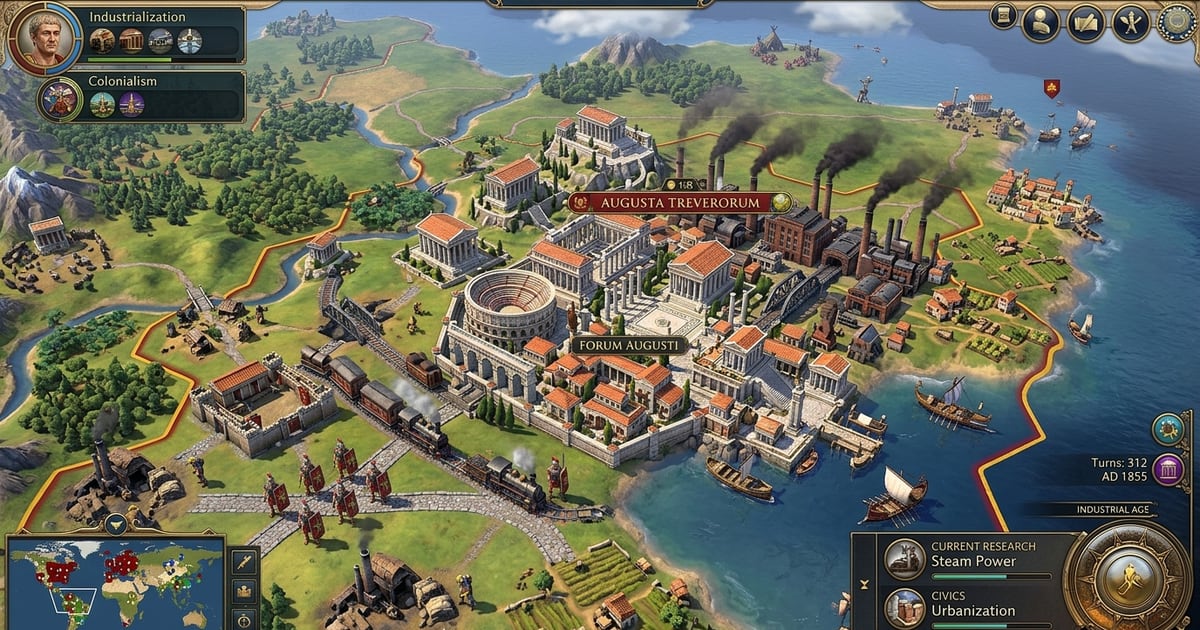
Sid Meier’s Civilization VII fundamentally reconstructs the 4X4X. eXplore, eXpand, eXploit, eXterminate — a grand-strategy subgenre about building a civilization over a long arc. formula by discarding the traditional uninterrupted 6,000-year tech climb. Instead, matches are divided into three distinct, self-contained historical chapters: the Antiquity Age, the Exploration Age, and the Modern Age. Surviving the climactic Crisis phase that concludes each age is paramount to securing victory.
Key Takeaways
- Three Historical Acts: Each match spans Antiquity, Exploration, and Modern ages, each featuring dedicated tech trees, civic progression, and civilization rosters.
- Crisis Management: The final 20% of an age introduces disruptive Crisis Policies that test empire stability, loyalty, and economic resilience.
- Civilization Transformation: Players choose a new historical civilization at the dawn of each age based on geographical lineage, leader attributes, or unlocked legacy triumphs.
The Three Ages Structure and Legacy Carryover
| Era | Focus Systems | Available Civilizations (Examples) | Crisis Archetypes |
|---|---|---|---|
| Antiquity Age | Pantheon beliefs, river valley agriculture, regional wars | Egypt, Rome, Maya, Han, Maurya | Barbarian migration, drought, plague |
| Exploration Age | Oceanic navigation, religious schisms, colonization | Normans, Spain, Abbasids, Ming, Chola | Religious heresy, colonial rebellion, privateers |
| Modern Age | Ideological blocs, industrial factories, global warfare | America, Britain, Meiji Japan, USSR | Economic depression, ideological riots, pollution |
Crisis Resolution Protocol
As an age approaches its conclusion, the Crisis meter fills. Every turn, players must absorb adverse Crisis Cards that challenge their empire’s cohesion:
- Economic Shock Cards: Slash gold per turn and reduce food yields; mitigate by stockpiling luxury resources and building granary reserves before the Crisis begins.
- Internal Secession: Discontent settlements threaten to secede into independent city-states; station garrison commanders and maintain high amenity ratings.
- Legacy Points Conversion: Successfully managing crises awards Legacy Points that translate directly into golden age bonuses, unique policy cards, and free starting units in the subsequent age.
Selecting Your Next Civilization
When entering a new age, you are not locked into historical determinism. An Antiquity Egypt player can transition into the Abbasids or Normans depending on whether they unlocked naval exploration legacies or cavalry milestones.
Age Transition Mechanics: Legacies, Persistence and Continuity
A Firaxis developer diary written by creative director Ed Beach frames an Age Transition as three decisions: you select a new civilization, you choose which Legacies to retain, and the game world evolves. Legacies are not free choices. They can only be picked if you have earned enough Legacy Points, which the diary says are obtained primarily by completing milestones in the four Legacy Paths. A Science milestone pays a Science point that can be spent on a Science Legacy in the next Age. Costs vary widely: Leader Attributes take a single point and can be acquired in bulk, Golden Age Legacies are more expensive and may demand prerequisite accomplishments, and Change Capital is free, letting you move an inland capital to one of your settlements on the coast. Completing a Legacy Path in full unlocks a Golden Age Legacy for the next Age, while failing even one milestone of a Path leaves you the associated Dark Age Legacy.
Age Progress runs on the same currency of turns. Every turn adds a small amount, and Legacy Path milestones add larger amounts; Beach puts a standard-speed Age at roughly 150 to 200 turns, or three to four hours.
Identity is what carries the transition. Leaders persist across all three Ages and keep leveling their attributes; Traditions unlocked through a civilization’s Civics tree remain usable as social policies in any Age; Ageless buildings, built Wonders and unique Quarters stay on the map; and Commanders keep their attributes and experience. Buildings are the exception. You will also be able to “overbuild” - construct new buildings on top of old ones - and the old buildings have reduced yields as they are less powerful in the new Age.
| Element | Behaviour across the transition |
|---|---|
| Leader | Persists across all three Ages and keeps gaining attributes |
| Traditions | Remain usable as social policies in any Age |
| Wonders, Ageless buildings, unique Quarters | Remain on the map |
| Commanders | Keep their attributes and experience |
| Obsolete buildings | Carry reduced yields and can be overbuilt |
| Buildings (after Update 1.2.3) | Keep full base Yields and Maintenance; lose adjacencies and special effects |
Update 1.2.3, released on July 22, 2025, also added an Advanced setting for the type of transition impact, with the new default option called Continuity and the older behaviour kept as Regroup. Under Continuity your Units stay where they were in the previous Age but are upgraded to their new version, Units inside another player’s borders are expelled as if you had lost open borders, and you can transition with Ships and Siegesiege. A timed, large-scale attack on a settlement — attackers try to destroy it, defenders try to hold it. Units from Antiquity to Exploration plus Settlers, Migrants, Scouts and Merchants in all Ages. Continuity also removes the Advisor Warnings for large armies. Saves created before 1.2.3 still use Regroup. The same update added a ten-turn-or-longer safe zone at the end of each Age, extendable to twenty turns or switchable off, during which no Age progression is added from any source other than elapsed turns.
Crisis control landed in Update 1.2.2 on June 23, 2025. Players can now pick and choose which Crises are enabled, and if more than one is enabled for an Age the game randomly chooses one from the pool of enabled Crises. That update also added an option to Bypass Civilization Unlocks, letting a player choose any civilization for the next Age regardless of unlock requirements.