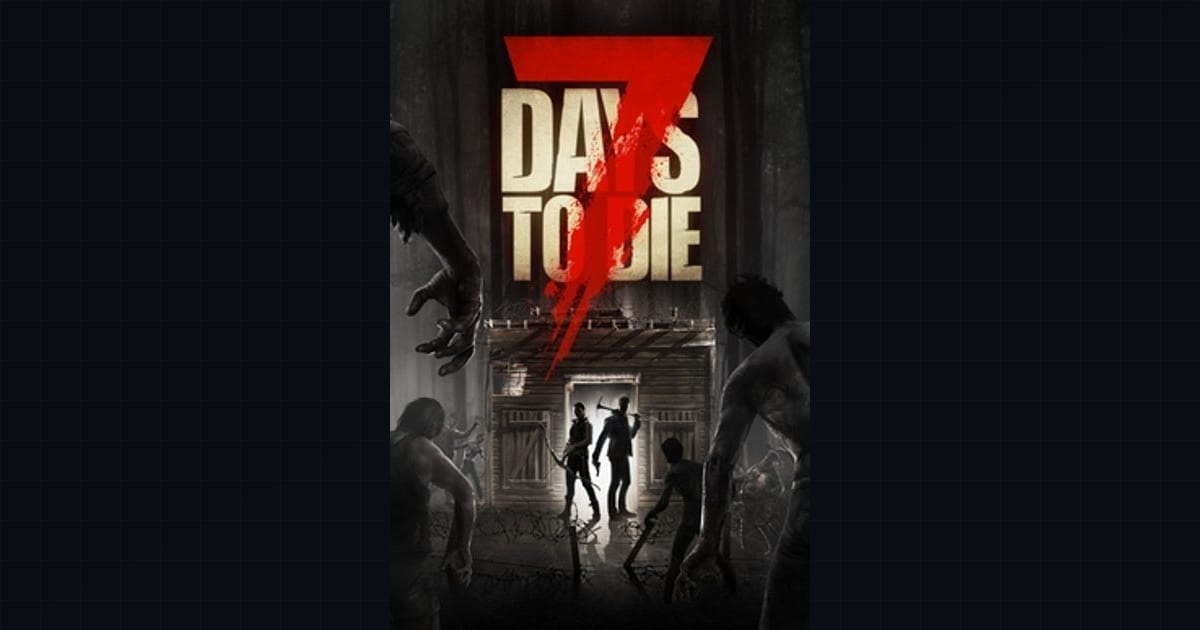
A first run in 7 Days to Die does not start where most guides start any more. The game left Early Access on 25 July 2024, after a public build history Steam dates to 13 December 2013, and since June 2026 it has been patched on a rhythm that quietly changes the rules a returning player learned: 150 sandbox options, a new loot-scaling layer, a different inventory grid, a search bar. The Fun Pimps put lifetime sales at “over 20 million copies sold” in March 2026, when the studio joined Behaviour Interactive — the same post in which the team says it will “continue to lead development, just as we always have.”
That volume of change is the problem for someone arriving now. A guide written before June 2026 describes a different loot system, a different difficulty contract, and a 9×5 inventory that no longer exists. This page is the entry point: which build to install, what each 3.x patch changed, and how the two systems that decide your first week — the Blood Moon horde and the sandbox presets — behave. It assumes the V3.4.0 stable build released 26 October 2026, and notes where the experimental branch differs.
What this covers: the current 7 Days to Die build, the ladder from 1.0 to 3.4.0, what the 3.x updates changed, and how the Blood Moon horde, Game Stage and the sandbox presets work on a first run. Why it matters: 150 sandbox options and a reworked inventory mean most advice older than June 2026 describes a game you cannot install. Who should care: first-time buyers, returning players whose last world predates V3.0, and anyone setting up a server for friends.
The version ladder, and which branch to install
Two builds can be installed: the default public branch and the experimental branch. The V3.1.0 notes name the first — “you will need to select the correct branch, Default Public Version” — while the V3.4.0 experimental changelog gives the opt-in path: right-click the game in Steam, open Properties, and pick latest_experimental from the Game Versions & Betas dropdown. Experimental builds publish a known-issues list rather than a stability promise, and the V3.4.0 list included “Locked slots reset after closing inventory” — a bug that breaks a habit many players relied on.
| Build | Date | Status | Headline change |
|---|---|---|---|
| 1.0 | 25 Jul 2024 | baseline | Left Early Access on PC |
| V2.6 | 1 Apr 2026 | superseded | City hitching addressed, dew collectors require jars, harsher snow and wasteland game stage |
| V3.0.0 “Dead Hot Summer” | 29 Jun 2026 | superseded | 150 sandbox options, Item Magnitude, 60+ new POIs |
| V3.1.0 “Henpocalypse” | 27 Jul 2026 | superseded | Chicken coops and a day/night split for density settings |
| V3.2.0 | 26 Aug 2026 | superseded | A dedicated small-update team, Combine Station UI, horn-opened trader doors |
| V3.3.0 | 5 Oct 2026 | superseded 26 Oct 2026 | 8×6 grid, backpacks, 96-slot ceiling |
| V3.4.0 | 26 Oct 2026 | stable, this guide’s baseline (b9 hotfix) | Backpack and container search, drone recovery |
Dates are the publication dates on the game’s Steam news feed. The pattern is the story: five version releases between late June and late October 2026, which is what the V3.2.0 post announced it would do. “You’ll be seeing more drops like this one — 3.1, 3.2, and beyond — coming your way more regularly,” it reads, describing “a dedicated team focused specifically on these smaller updates,” separate from the major-release teams, with “work on v4.0” continuing “in parallel.”
For a new player the reading is simple: install the default branch. Experimental changelogs are bug lists written for people who will file more bugs.
What V3.0 changed, and why older advice misleads
V3.0 is the largest single change since release, and the reason an older guide is unreliable. The notes describe the intent as “a core philosophy of player agency,” and the headline number is “150 sandbox customization options” — enough that The Fun Pimps ship their own presets: Undead Matinee (slow, swarming, scarce ammo), Madmole’s Mayhem (item loss on death), Bite Club (perma-death), Legacy Survival and Chibi Mode, alongside the classic difficulty presets. Presets can be named and shared, and server admins migrating a V2.6 world must rebuild settings as a SandboxCode string in serverconfig.xml; the notes give the default and state it is “an equivalent setup of the legacy default GameDifficulty setting of ‘Adventurer’ or 1.”
The second system is loot. V3.0 added Item Magnitude: looted weapons, tools and workstation mods can roll boosted stats, marked with an orange star and a teal percentage. Mods gained quality levels, and the notes show the spread — “A Quality 1 Grave Digger mod adds 5% dirt damage, while a Quality 6 version adds 30%” — while simple on/off mods such as the Helmet Light stay single-version. A new Combine Station merges the attributes of two similar items to push a stat upward, and offers a repair route.
Two smaller items show up in every world: 60+ new POIs and an M60 turret that “uses all 7.62 ammo types” for late-game hordes. The main menu was redesigned in V3.0, but “the full in-game interface overhaul is still to come in a future release” — do not expect the HUD to match the front end.
The four updates since 3.0
V3.1.0, Henpocalypse. Chickens. You catch a live bird, cart it home while zombies chase you, and put it in a Chicken Coop with three tool slots: a Brooding Lamp that “speeds up production and chicken maturation,” a Chicken Run that “lets chickens hunt for bugs, cutting feed cost by 50%,” and a Nesting Box that “unlocks chicken breeding and adds nesting slots.” Feed is corn and rotting flesh, and a captured bird’s stress meter, at 100%, drops it and triggers an event scaled to your game stage. This patch also split enemy and animal density into day and night settings, warning that “invalid codes may default some or all settings” — old preset codes need re-checking. V3.2.0, a month later, was quality-of-life only: horn-opened trader doors and a Combine Station rework where “a plus will indicate that an item was combined.”
V3.3.0. The inventory rework. The grid becomes 8×6 — “4 rows of free-to-use slots and 2 rows of encumbered slots. A total of 48 slots which is 3 more slots than the legacy 9x5 grid” — and backpacks “come in Small, Medium and Large sizes with 6 quality levels each,” filling the new Backpack slot to reach “up to a total of 96 slots in an 8x12 grid.” The Pack Mule perk and Armor Pocket Mods remove the encumbrance afterwards. If the per-quality slot table and the horde-base consequences are your question, the V3.3.0 backpack and horde base guide works through both — including what happens to a bag’s contents when you unequip it mid-fight.
V3.4.0. A search bar and category filters for backpack and containers, plus trader-based recovery for a lost drone. The changelog also retunes items built around the old capacity — “Night Stalker Vol. 4, Steroids, Chicken Nuggets, and the completed Fireman’s Almanac set” — and fixes the tenth hotbar slot being unsellable. The V3.4.0 experimental write-up covers the opt-in and the bugs; its framing predates the stable promotion, so “experimental” there is now the default branch. One warning survives it: joining a server on 3.4.0 b6 or later “may transform some resource items from a client’s 3.3 inventory into different items.”
What a first Blood Moon actually asks of you
The horde is the appointment the game is built around, and the official wiki is precise about its schedule. Frequency is “every 7th day (e.g., Day 7, Day 14, Day 21, etc.)” and the horde “starts at 22:00 and ends at 04:00 the next day.” The build-up runs on a fixed clock:
| Time | What happens |
|---|---|
| 08:00 | The day number in the HUD turns red |
| 18:00 | A crack of thunder; the sky begins to turn red |
| 21:00 | Sky is heavily red; the storm is fully overhead |
| 22:00 | A directionless scream, then the first wave spawns at a distance |
Two rules decide that night, and neither has an in-game workaround. Zombies in a Blood Moon Horde “know exactly where all players are regardless of how quiet the players are, how many walls they hide behind, or how deep underground they go,” and will “break down obstacles, climb, or dig as they are able.” A wave ends when its zombies are dead or a maximum duration expires, and “each subsequent wave is more numerous and more difficult,” with the wave count set by Game Stage. Killed zombies are replaced from a distance, so the horde does not shrink as you thin it.
The constraint behind every base follows: you are not hiding, you are choosing which blocks the horde has to eat. The horde-base guide covers the design families; the point for a first world is that a base you cannot reach to repair during a wave fails on its second night.
The other numbers: Game Stage, Loot Stage and storms
Game Stage is the dial that reads your progress and sets the horde. The wiki gives the single-player formula as ”([Player Level] + [Adjusted Days Alive]) * [Difficulty Factor] (1.2),” with days alive reduced for each death, and flags that it is stated “as of Alpha 19.” Treat the arithmetic as shape rather than guarantee: levelling and surviving both raise it, so a cautious player who never dies still meets a bigger horde on day 50 than on day 8. It sizes hordes, including sleeper and screamer spawns, and does not govern loot.
Loot Stage is the separate value. The wiki dates the split to “Alpha 20” and lists its inputs as the Lucky Looter perk, Lucky Goggles, Eye Kandy, and the biome, POI and even the specific container — with the explicit note that “the number of days the player has been alive does not affect the Loot Stage.” Empty containers respawn loot “after 30 days by default.” The consequence is counter-intuitive: dying costs you Game Stage and therefore horde pressure, but it does not roll back what you can find. Every clock described here has an off switch — blood moon frequency, count and warning, global and biome game stage, loot abundance and max loot tier, storm frequency and warning are all sandbox options, covered next.
Storms are the second clock, and the one new players meet unprepared. The wiki describes a siren with a warning message, then a one-minute countdown before a stage-1 debuff with a visible timer, escalating to stage 2 thirty seconds later. Shelter means being separated from open areas “by Blocks on all sides and above,” with doors counting only when closed, and leaving the biome lets the timer regenerate. Insulation “extends the stage 1 timer by 30 seconds per 1 insulation.” Two side effects are easy to miss — “zombies always run during Storms,” and vehicles have reduced turn speed, making a storm a bad time to drive fast.
The sandbox settings worth touching in week one
The 150 options are not all equal. The useful ones in a first world are those that change what a mistake costs, and a set you like can be exported and reused.
| Option | What it governs | Why it matters in week one |
|---|---|---|
| Blood Moon Frequency / Count / Warning | Whether the weekly horde happens, and how big it is | The biggest difficulty lever; a learning world can run a slower cadence |
| Zombie Digging | Whether zombies can mine through your walls | Off removes an entire class of base failure |
| Encumbrance Slots | How many slots slow you before Pack Mule | Interacts with the 8×6 grid and backpack sizes |
| Loot Abundance / Max Loot Tier | How much loot spawns and how high it scales | Faster early progression without touching combat |
| XP Multiplier / Base Skill Points | Pace of character growth | The cleanest way to shorten a first run’s grind |
| New Player Buff / Intro Quest | Whether the opening guidance runs | Check before declaring the game has no tutorial |
| Trading Enabled / Trader Hours | Whether traders buy, sell and offer quests | Traders are the quest hub; off changes the loop |
One caution: V3.1.0 split density options into day and night variants, and V3.0 replaced the legacy serverconfig.xml properties outright, so an older preset code may partially fail — invalid codes “may default some or all settings.” Verify any code in the menu before starting a world.
Platforms, storefronts and the console edition
The game is sold on PC, PlayStation and Xbox, and patches land on all three together — the V3.1.0 notes open with “3.1 stable is officially live on PC, PlayStation, and Xbox,” and the V3.4.0 stable post describes a hotfix “deployed on all platforms.” The official Buy page links Steam, the PlayStation Store (listed as 7 Days to Die — Console Edition on PS5) and the Xbox store, where the listing carries the suffix “(Game Preview)” for Xbox Series X|S: the PC release is a finished 1.0 product per its Steam release date, and the Xbox console edition is still filed under the preview label.
The Steam page lists Windows, macOS and SteamOS + Linux builds, five biomes, worlds “up to 100 square kilometers,” over 500 recipes, roughly 60 zombie archetypes and more than 700 locations.
Known issues to read before you commit a weekend
The V3.3.0 notes shipped a known-issues list that was not fully cleared before 3.4.0, and three entries affect ordinary play rather than edge cases: consuming items from a campfire requires transferring them to the backpack first, the tenth item on the hotbar could not be sold, and changing the language setting on macOS could freeze the game hard enough to force a quit. A rare null-reference exception when generating chunk decorations applies to new games only, and the Euthanizer perk was listed as triggering without working. The tenth-hotbar fix landed in V3.4.0; if a campfire refuses to feed you, that is the known bug, not your inventory.
Next read
If a specific question brought you here, the depth is elsewhere on this site rather than in this page.